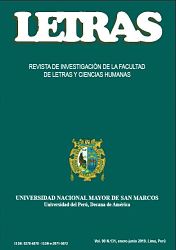
The NÄyaka (hero) and the NÄyikÄ (heroine) in the Sánskrit Poetics
DOI:
https://doi.org/10.30920/letras.90.131.10Abstract
In Sanskrit poetry, extremely important aspects of poetry converge that promote human emotions and feelings from the perspective of eroticism. The prestigious Sanskrit literary tradition is basically centered on the poetic construction and the invention of stereotyped characters that promote the literary conventions of the Sanskrit lyric. The participants in these affluents of emotions and feelings embody the two characters have been described in different works on Sanskrit poetics. Hence the interest and the essential objective of these lines of research on Sanskrit poetics through the theorization and analysis made by Sanskrit theorists of both the hero and the heroine.Downloads
References
Arenas, C. & Puigcerver, A. (2009). Diferencias entre hombres y mujeres en los trastornos de ansiedad: una aproximación psicobiológica. Escritos de Psicología, 3(1), 20-29. Recuperado de http://scielo.isciii.es/scielo.php?pid=S1989-38092009000300003&script=sci_arttext
Beuchot, M. (2004). El ser del símbolo. En M. Beuchot, Hermenéutica analógica y símbolo (pp. 144-147). Ciudad de México: Herder.
Beuchot, M. (2007). Símbolo, analogía e iconicidad. En M. Beuchot, Hermenéutica analógica, símbolo, mito y filosofía (pp. 13-24). Ciudad de México: Universidad Nacional Autónoma de México.
Bravo Alatriste, P. K. (2008). Amparo Dávila y las cuentistas del género fantástico en el medio siglo. Tema y variaciones de literatura: la generación de medio siglo I. Las escritoras. 30, 133-155. Recuperado de http://zaloamati.azc.uam.mx/bitstream/handle/11191/2696/Amparo_Davila_y_las_cuentistas.pdf
Dávila, A. (2014). El huésped. En A. Dávila, Cuentos reunidos (pp. 19-23). Ciudad de México: Fondo de Cultura Económica.
American Psychiatric Association - APA. (2003). Trastornos de ansiedad. En Manual diagnóstico y estadístico de los trastornos mentales DSM-IV-TR (pp. 477-544). Barcelona: MASSON S. A.
Längle, A. (2005). La Búsqueda de Sostén. Análisis Existencial de la Angustia. Terapia Psicológica, 23(2), 57-64. Recuperado de http://www.redalyc. org/pdf/785/78523206.pdf.
Lovecraft, H. P. (2014). Supernatural horror in literature. Australia: The University of Adelaide. Recuperado de http://ebooks.adelaide.edu.au/l/lovecraft/hp/supernatural/index.html.
Lovecraft, H. P. (2016). "Notes on writing weird fiction". En The Collected Works of H.P. Lovecraft. Recuperado de https://archive.org/stream/TheCollectedWorksOfH.p.Lovecraft/The-Collected-Works-of-HP-Lovecraft#page/n11/mode/2up
Ramírez-Arballo, A. (2010). El lector analógico. Revista Hermes Analógica, 1. Recuperado de https://bit.ly/2MFgCyc
Roas, D. (2001). "La amenaza de lo fantástico". En D. Roas, Teorías de lo fantástico (pp. 7-44). Madrid: Arco Libros.
Roas, D. (2009). "Lo fantástico como desestabilización de lo real: elementos para una definición". En T. López Pellisa & F. Moreno Serrano (Eds.), Primer Congreso Internacional de literatura fantástica y ciencia ficción (pp. 94-120). Madrid: Asociación Cultural Xatafi. Recuperado en https://teorialiteraria2009.files.wordpress.com/2016/05/roas-lo-fantastico-como-desestabilizacic3b3n-de-lo-real.pdf
Roas, D. (2011). Tras los límites de lo real: Una definición de lo fantástico. Madrid, España: Páginas de Espuma.
Sierra, J. C., Ortega V., & Zubeidat, I. (2003). Ansiedad, angustia y estrés: tres conceptos a diferenciar. Revista Mal Estar e Subjetividade, 3(1), 10-59. Recuperado de http://pepsic.bvsalud.org/pdf/malestar/v3n1/02.pdf
Published
How to Cite
Issue
Section
Este obra está bajo una licencia de Creative Commons Reconocimiento 4.0 Internacional